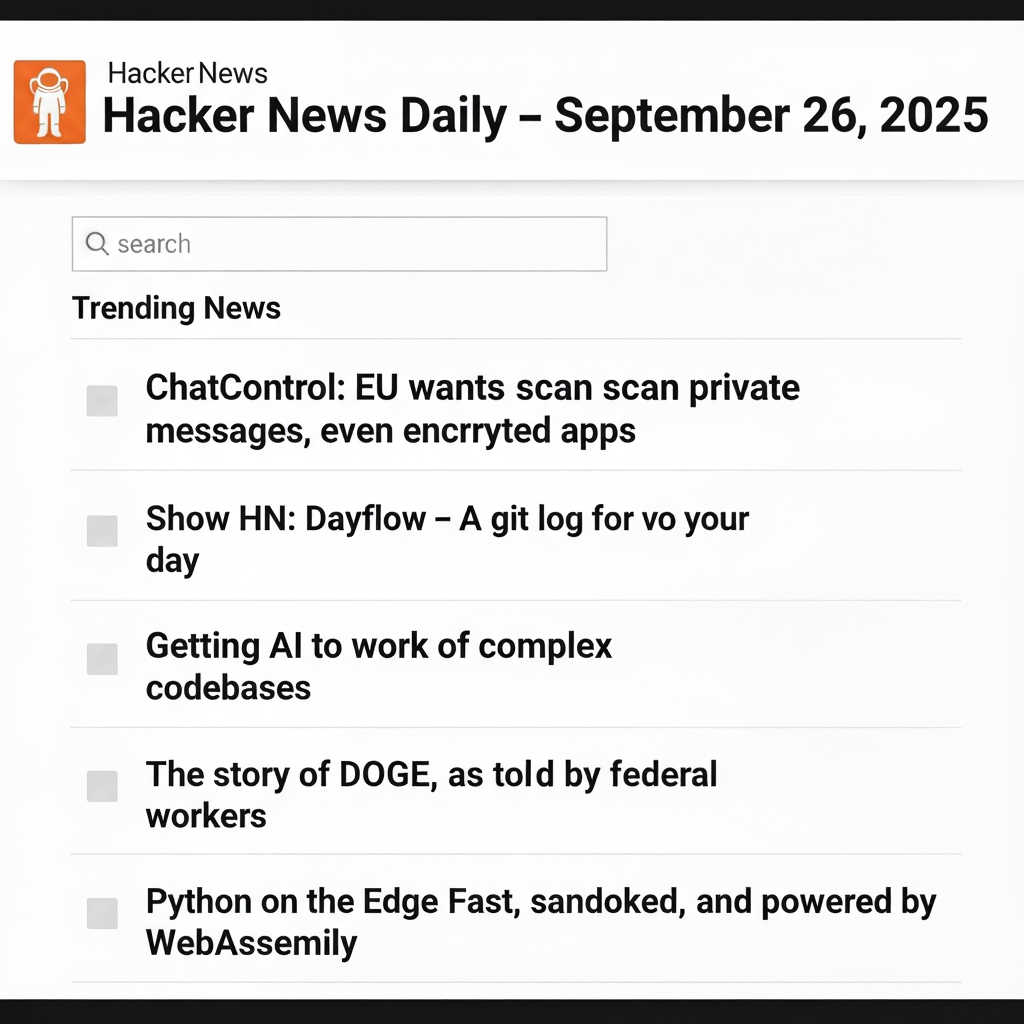
ChatControl: EU wants to scan all private messages, even in encrypted apps
An analysis of the EU’s proposed ChatControl regulation that mandates tech companies to scan private messages for child abuse material, raising concerns about privacy, encryption, and civil liberties.
Insights from People’s discussions:
- Opposition to Surveillance Legislation: Strong criticism of proposed laws enabling government access to encrypted communications, citing privacy violations, potential for mass surveillance, enabling monitoring of lawful activities, lack of transparency, reliance on unauditable systems, and a slippery slope towards thought crime. (Sentiment: Negative)
- Critique of CSAM Detection Measures: Concerns that proposed detection systems (like ChatControl) are ineffective, easily circumvented, overly broad, potentially enable mass surveillance, lack transparency, and may be influenced by corporate interests. There is also skepticism about their effectiveness and the politicians’ understanding of encryption. (Sentiment: Negative)
- Debate on EU Democracy and Sovereignty: A divided view regarding the EU’s role. Some criticize it as undemocratic due to unelected officials and perceived loss of national sovereignty concerning these regulations. Others defend it as a necessary institution and suggest ways to make it more democratic or limit its power. (Sentiment: Mixed - Negative towards EU, Positive/Neutral towards suggestions for change)
- Privacy Erosion and Democratic Concerns: Widespread fear that these proposals represent a significant infringement on fundamental rights and privacy, reversing the presumption of innocence, and potentially concentrating too much power in the hands of the government, leading to a chilling effect on free expression. (Sentiment: Negative)
- Difficulty of Stopping Irreversible Measures: The view that certain proposals persistently resurface despite opposition, making them difficult to stop and potentially irreversible once approved, demanding constant vigilance from citizens. (Sentiment: Negative)
Show HN: Dayflow – A git log for your day
An introduction to Dayflow, a macOS application that uses local Vision Language Models to track actual work activities by analyzing screen content.

Insights from People’s discussions:
Desire for Better Time Tracking Tools: Users express a strong need for improved time tracking, focusing on accuracy (preventing forgotten work), cross-platform availability (especially Linux), open-source options, local processing, and features like client/project association. (Sentiment: Positive)
Privacy Concerns with AI Features: Significant worry is voiced about the privacy implications of AI features involving screen data (OCR, recording), questioning data security, potential leaks, weak password handling, and the perceived “spyware” nature of some tools. *(Sentiment: Negative)
Performance & Cost Trade-offs: Comments discuss the performance differences between cloud AI services (like Gemini) and local models, noting the high token costs of cloud services (especially for video) versus the privacy and offline benefits of local models, despite potential quality differences. *(Sentiment: Neutral)
Technical Implementation & Usability Issues: Users detail specific problems encountered with tools, including limitations (multi-monitor recording), technical hurdles (running local models), and general usability concerns. *(Sentiment: Negative)
Getting AI to work in complex codebases
This article explores the application of advanced context engineering techniques to enhance coding agents using large language models.
Insights from People’s discussions:
- Skepticism Regarding Dramatic Productivity Gains: The overwhelming sentiment is that claims of generating massive amounts of code (like 35k LOC in 7 hours) are questionable, often ignoring code quality, the engineering effort required to manage and refine AI output, and the validity of the speed claims. (Sentiment: Negative/Mixed Skepticism)
- Necessity of Human Oversight and Context: A core viewpoint emphasizes that effective AI use requires significant human intervention, including providing context, clear instructions, managing the AI’s output, and performing complex problem-solving and creativity – suggesting AI doesn’t replace but rather shifts the focus of developers. (Sentiment: Negative/Concerned)
- Debate on AI’s Role (Tool vs. Delegation/Abstraction): There’s discussion about whether AI-assisted workflows represent a useful abstraction or simply a form of delegation, reducing cognitive load but potentially changing the nature of the work done by humans. Some see it as a positive tool, others are wary of its implications. (Sentiment: Mixed - Concerned about Delegation, Positive about Tool Use)
- Concerns About AI Output Quality and Reliability: Comments frequently highlight the unreliability and often poor quality of AI-generated code, questioning its practicality and the effort needed to make it usable without significant human intervention. (Sentiment: Negative)
- Developer Frustration and Devaluation of Skills: Many commenters express frustration at the shift towards managing AI systems and performing incremental tasks, feeling this devalues core software engineering skills and contradicts traditional practices. (Sentiment: Negative/Frustrated)
- Context Specificity (Go vs. Python, High vs. Low Code Volume): The discussion touches on how language choice (Go vs. Python) and the volume of code (high vs. low) can influence the perceived effectiveness and validity of AI coding claims. (Sentiment: Neutral - Contextual)
- Debate on Terminology (“Vibecoding”): There’s disagreement on the term “vibecoding,” with some finding it inaccurate or pejorative for AI-assisted or less-thoughtful coding, others defending its original meaning (unreviewed AI code), and suggestions for alternative terms. (Sentiment: Mixed - Some Defensive, Some Seeking Better Terms)
The story of DOGE, as told by federal workers
The article chronicles the establishment and impact of the Department of Government Efficiency (DOGE) within the US federal government, focusing on its workforce reductions, operational changes, and the controversies surrounding its influence.

Insights from People’s discussions:
- Concerns about Authoritarian Government Actions & Institutional Dismantling: Widespread criticism of government actions seen as overly aggressive or authoritarian, coupled with fear that venture capital/Silicon Valley influence is eroding traditional institutions and devaluing essential workers, leading to societal polarization. (Sentiment: Negative)
- Criticism of DOGE’s Methods, Impact, and Bias: Significant criticism directed at DOGE’s approach to government efficiency, including accusations of indiscriminate agency cuts, questionable savings figures, potential bias in its operations, and negative long-term consequences despite initial spending reductions. (Sentiment: Negative)
- Mixed Views on US Digital Service & Reform Efforts: A more nuanced perspective acknowledging the initial promise and some successes of government reform initiatives like the US Digital Service, but expressing skepticism about their lasting impact, implementation challenges under recent administrations, and the overall effectiveness of the current approach to bureaucratic change. (Sentiment: Mixed)
Python on the Edge: Fast, sandboxed, and powered by WebAssembly
Wasmer Edge introduces beta support for running Python applications directly on WebAssembly with enhanced performance and sandboxing.

Insights from People’s discussions:
- Running Python in WASM (Wasmer, Pyodide, JupyterLite): Exploration of tools enabling Python execution outside the browser via WASM, highlighting potential benefits like sandboxing and deployment ease. (Sentiment: Positive/Negative - Generally positive about the potential, negative/negative about the current implementation challenges).
- Challenges with WASM Python Implementations: Identification of specific technical difficulties encountered, such as C extension compatibility, asyncio support, exception handling, and network request issues, particularly with early Wasmer versions. (Sentiment: Negative - Focused on the problems and limitations).
- Use Cases, Alternatives, and Interoperability: Discussion of potential applications (robotics, education, edge computing), comparison with other languages (Lua) and approaches (embedding Python directly), and the necessity for FFI (Foreign Function Interface) support for libraries like NumPy. (Sentiment: Neutral - Informed discussion about feasibility, comparisons, and requirements).